

“To be a woman was to watch yourself not just through your own eyes, but through the eyes of others.”
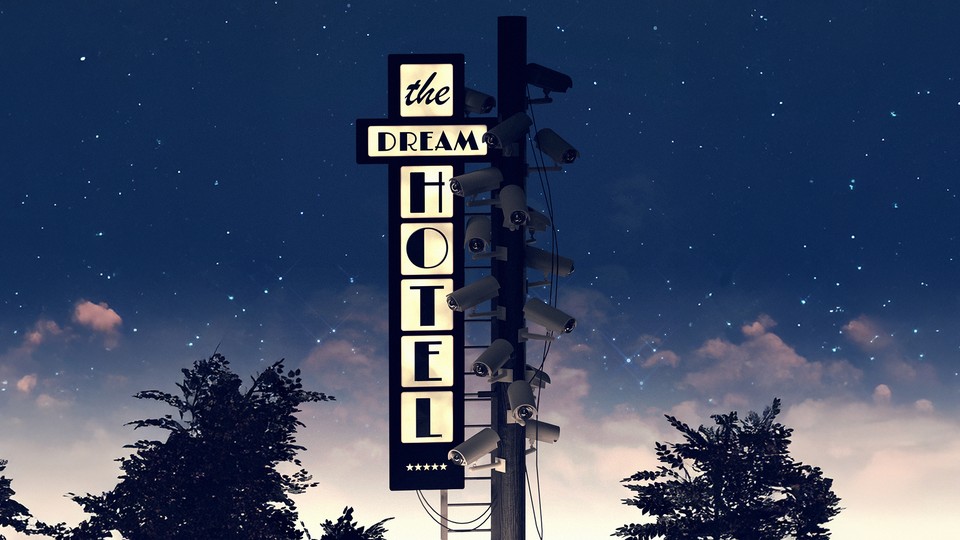
If we hosted a competition tomorrow for “words of the decade,” we’d bet that data, surveillance, and technology would be one of the frontrunners. It’s precisely that sense of timeliness that has made The Dream Hotel one of the most talked-about books of the year so far. We came across the novel’s premise a few months ago, and its premise – a chilling feminist dystopia about the seductive lure of technology and the slow erosion of privacy – promised something truly gripping and unsettling. But, did this hyped book club pick live up to its undoubtedly unique premise? Join us at What We Reading for our The Dream Hotel book review to find out!
Date Published: 2025
Author: Laila Lalami
Genre: Science Fiction, Dystopia
Pages: 336
Goodreads Rating: 3.60/5
The Dream Hotel Summary
Sara Hussein has just landed at LAX when agents from the Risk Assessment Administration pull her aside and inform her that she is about to commit a terrible crime. Using data plucked from her dreams, the RAA’s algorithm has determined that she poses an imminent threat to the person she loves most of all: her husband. For everyone’s safety, she must be detained for twenty-one days of observation.
Sara is transferred to a retention centre known as Madison, where she joins other “dreamers” – all women – who are being held for crimes that haven’t been committed yet. With each infraction of the facility’s ever-shifting rules, their release dates are extended further. Weeks turn into months, and Sara finds herself ensnared in a system designed to keep her there.
When a new resident arrives and upends the fragile order of the facility, Sara is hauled further into a confrontation with the institutions and corporations that have robbed her of her freedom. The Dream Hotel is a novel that explores the seductive lure of technology – how it promises safety and convenience, even as it quietly tightens its grip on us.
What Worked
This is Laila Lalami’s fifth novel, and her experience shows throughout The Dream Hotel. The prose is polished and controlled, and the descriptions of the Madison facility are clear and grounded.
The inclusion of transcripts, meeting notes, and newspaper excerpts all adds texture to the worldbuilding. These fragments provide us with a nice peek behind the curtain of the institutions at work and provide the narrative with a nefarious bureaucratic chill. When they work well, these sections carry with them a deliciously sinister undertone – the kind of unsettling mystery we wish the rest of the novel had managed to convey.
And, undeniably, the premise itself is compelling. AI data mining, behavioural prediction algorithms, and the idea of dreams being harvested for surveillance create a concept that feels disturbingly plausible. On paper, it’s precisely the sort of dystopian setup that should be impossible to put down.
What Didn’t
Unfortunately, this is really where our enthusiasm for The Dream Hotel comes to a close.
Our number one issue with The Dream Hotel was its characters. Inside the Madison facility, both detainees and staff blend together in a way that makes them difficult to distinguish. Few feel fully formed, and none demonstrate meaningful growth or any real development over the course of the story.
When you frequently find yourself pausing to work out who’s speaking – or struggling to grasp what makes one character distinct from another – the momentum quickly fades. Rather than building tension, the story starts to feel flat.
Sara herself might be the protagonist, but she’s no better. As a main character, she remains emotionally distant and largely static. Her internal reflections orbit the same ideas without ever deepening them, and her journey lacks the transformation that might have given the story some weight. In a book that is so hyper-fixated on personal autonomy and resistance, the absence of development is especially palpable.
Despite its provocative concept, the execution feels muted. The tension never quite escalates; the plot unfolds without urgency, and the payoff lacks impact. For a story constructed on such an eerie foundation, it rarely feels suspenseful.
We rarely ever struggle to finish a book or find a good chunk of positive things to talk about. But, with The Dream Hotel, it felt as though we went well beyond the point of anger and became more and more indifferent – checked out and disappointed rather than challenged.
Verdict
There’s no denying that The Dream Hotel taps into urgent, contemporary anxieties about surveillance, technology, and the commodification of our most private selves. Its premise is sharp, timely, and brimming with potential.
Sadly, that premise is where most of our praise begins and ends.
The novel is full of characters who feel more like placeholders than people, drifting in and out of a narrative that never quite gets going. Whilst Lalami’s prose is clean and controlled, it lacks the distinctiveness or emotional intensity that might have made the story stick a bit more.
This hasn’t put us off dystopian fiction altogether, but it has reminded us not so easily fall in love with a concept before seeing how it’s executed. The Dream Hotel is an intriguing idea wrapped in a story that, for us, never truly came alive.
Perhaps this is just a book we just didn’t get though! Feel free to let us know where we went wrong with The Dream Hotel in the comments below!
Our Rating: 2/5

Part-time reader, part-time rambler, and full-time Horror enthusiast, James has been writing for What We Reading since 2022. His earliest reading memories involved Historical Fiction, Fantasy and Horror tales, which he has continued to take with him to this day. James’ favourite books include The Last (Hanna Jameson), The Troop (Nick Cutter) and Chasing The Boogeyman (Richard Chizmar).

